Biologic Drug Analytics
Cell-Based Assay Services
ProtaGene offers cell-based assay services that capture biological activity, potency, and mechanism-relevant signaling pathways in intact cells. The functional data supports sponsors in characterization, comparability assessment, structure-function correlation and release testing of biologic products.
The portfolio covers reporter gene assays, effector function bioassays (ADCC, CDC), cell viability & cytotoxicity assays, and molecule-specific assay development for antibody-based therapeutics, new biological entities (NBE), recombinant proteins and biosimilars.
What Cell-Based Assay Services Does ProtaGene Provide?
ProtaGene aligns each cell-based assay to target biology, mode of action, and the analytical question the sponsor needs answered. The capabilities cover three functional readout categories and custom development:
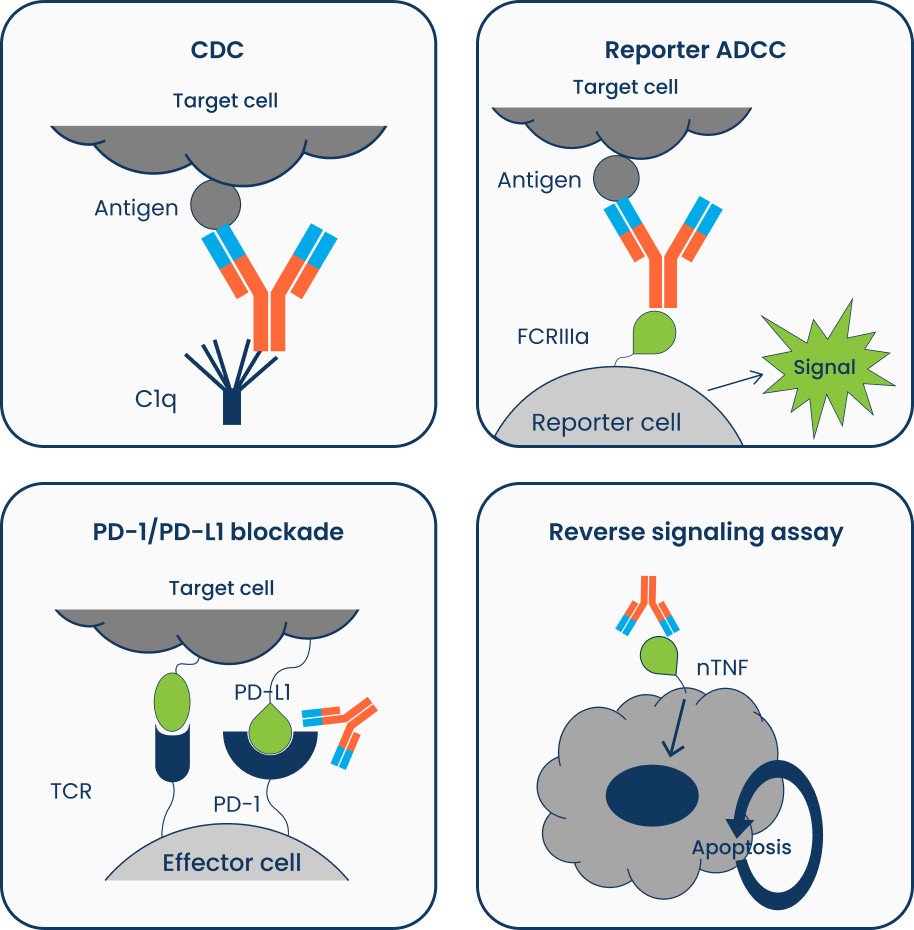

Reporter Gene Assays and Effector Function (ADCC, CDC)
ProtaGene runs reporter gene assays (RGA) that measure activation or inhibition along defined signaling pathways. Engineered reporter cell lines generate a bioluminescence-based signal that delivers robust detection and reproducible quantitation.
For monoclonal antibodies, bispecifics, ADCs, and Fc-engineered molecules, ProtaGene provides cell-based assays for antibody-dependent cellular cytotoxicity (ADCC) and complement-dependent cytotoxicity (CDC). These effector function assays evaluate whether the molecule engages the FcγRIIIa receptor or activates the complement system as intended by mechanism of action or as an unwanted side effect.
Reporter-gene assays generate the functional data sponsors use for potency characterization, comparability, and release testing.
-
Mechanism-aligned functional readouts across relevant signaling pathways
-
Reporter-based ADCC and complement-mediated CDC data for antibody effector function
-
Potency comparison across samples over a defined concentration range
-
Bioluminescence as preferred readouts for robust signal detection and reproducible quantitation

Cell Viability and Cytotoxicity Assays
ProtaGene measures cell viability, cytotoxicity, and apoptosis endpoints to evaluate how cells respond to a biologic beyond its intended target activity. The data provides context on cell health and treatment-related cellular response.
These readouts help sponsors distinguish on-target functional activity from background effects. Where mechanism-relevant, viability assays detect whether a monoclonal antibody initiates apoptosis in cells expressing the target antigen.
ProtaGene reports cell viability and cytotoxicity data alongside the corresponding cell-based assay format, readout system, and cell line, so the analytical context is documented for review and comparability.
-
Cell viability and cytotoxicity data to contextualize functional activity
-
Apoptosis readouts for monoclonal antibodies targeting antigen-expressing cells
-
Added insight into cell health and treatment-related cellular response
-
Results linked to the selected cell-based assay, readout system, and cell line

Custom Cell-Based Assay Development
ProtaGene develops molecule-specific cell-based assays tailored to target biology and the analytical question the sponsor needs answered. Different biologics require different assay concepts, controls, and cell lines.
Custom assay development covers fit-for-purpose formats for emerging modalities, checkpoint inhibitor assays such as PD-1/PD-L1, and assay strategies adapted to non-standard mechanisms of action.
ProtaGene defines cell line selection, readout strategy, controls, cell banking strategy, and acceptance criteria for each new assay. The goal is to support downstream release testing and characterization activities with interpretable, comparable results.
-
Fit-for-purpose cell-based assay development aligned to molecule and mechanism
-
Checkpoint inhibitor assay formats (PD-1/PD-L1) and emerging modality bioassays
-
Cell banking strategy and cell line selection for reproducible execution
-
Documentation that supports consistent execution and clear comparability across studies
Analytical Solutions from Research to Market
Biologic Therapeutics Platform Expertise
Our deep experience advancing a diverse range of therapeutic platforms from research through market help the ProtaGene team design highly effective analytical programs that de-risk development and accelerate timelines to your next key milestones. Key biologic development areas include:
-
Recombinant proteins—including complex, highly glycosylated proteins
-
Multi-subunit complexes—protein, nucleotide, ligand
-
mAbs
-
ADCs and protein conjugates
-
PEGylated proteins
-
Bispecifics/multispecifics
-
Fusion proteins
-
Enzyme replacement therapies
-
Biosimilars
-
Vaccines, including subunit/recombinant








































































































































































Analytical Systems
Enabled by state-of-the-art technology, ProtaGene offers an extensive range of analytical capabilities to support your biotherapeutic or gene & cell therapy projects.









































































































































































Why Choose ProtaGene for Cell-Based Assays?
ProtaGene operates GMP-certified contract laboratory services for protein analytical testing, with quality systems established since 2013. The team has performed biosimilar analytics since 2005 and has presented release testing concepts to the EMA biotech working party. Differentiators relevant to cell-based assays programs:
- Structure-function correlation through integration of cell-based assays with high-resolution mass spectrometry
- GMP-compliant cell culture and cell-based assay team with established quality systems
- Bioluminescence as preferred readouts for robust signal detection and reproducible quantitation
- Thaw-and-use working cell banks for fast turnaround and lot-to-lot consistency
- Four sites in the US and Germany with FDA and EMA regulatory experience
Subscribe to Our Email List
Talk to Our Cell-Based Assay Experts
Describe the molecule, the biologic samples to be evaluated, and the analytical decision the program requires. ProtaGene proposes a fit-for-purpose cell-based assay strategy with the appropriate format, readout, and timeline.
Contact UsFrequently Asked Questions
What is a cell-based assay?
A cell-based assay measures how living cells respond to a biologic or compound in a controlled cell culture environment. It captures functional readouts such as receptor activation, signaling pathway response, cell viability, or cytotoxicity. Cell-based assays preserve more of the native cellular context than purely structural measurements, which makes them useful for potency testing, mechanism of action characterization, and effector function evaluation in biologic drug development.
When are reporter gene assays used?
Reporter gene assays are used when sponsors need to quantify activation or inhibition along a defined signaling pathway. Engineered reporter cell lines generate a measurable signal, often bioluminescence-based, in response to the biologic. Reporter gene assays support potency determination, mechanism of action characterization, and lot-to-lot comparability. ProtaGene applies reporter gene formats for monoclonal antibodies, Fc-engineered molecules, checkpoint inhibitors, and other biologics where pathway-level readouts are required.
What is the difference between ADCC and CDC assays?
ADCC and CDC assays both evaluate antibody effector function, but they measure different mechanisms. ADCC assays measure antibody-dependent cellular cytotoxicity, the killing of target cells by immune effector cells engaged through the FcγRIIIa receptor. CDC assays measure complement-dependent cytotoxicity, the lysis of target cells through activation of the complement system. ProtaGene runs both formats, including reporter-based ADCC, to support potency characterization for monoclonal antibodies, bispecifics, and Fc-engineered molecules.
When should sponsors use cell viability and cytotoxicity assays?
Cell viability and cytotoxicity assays are used when sponsors need to evaluate how cells respond to a biologic beyond its intended target activity. These assays measure viability, apoptosis, and cytotoxicity endpoints to identify treatment-related cellular response and confirm that observed functional signals reflect the desired biological profile. The data complements potency and mechanism of action readouts and provides context for characterization, comparability, and analytical review.
Does ProtaGene develop custom cell-based assays?
Yes. ProtaGene develops molecule-specific cell-based assays tailored to target biology, mechanism of action, and the analytical question the sponsor needs answered. Custom assay development includes cell line selection, readout strategy, controls, cell banking strategy, and acceptance criteria. Typical applications include checkpoint inhibitor assays such as PD-1/PD-L1, assay formats for emerging modalities, and fit-for-purpose bioassays where standard formats do not match the product. All assays are built on established, characterized cell lines that the sponsor provides.
Still Have Questions?
Discover how ProtaGene can support your development programs.